Restoration of Saltpans for Conservation of Migratory Waterbirds in Kanyakumari District, Tamil Nadu
Challenges:
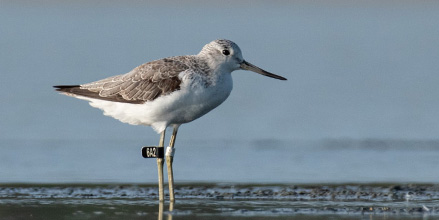
Saltpans in Tamil Nadu, especially in Kanyakumari district, have become crucial for waterbird conservation due to the loss of natural coastal wetlands from urban and industrial development. These saltpans support species like the Greater Flamingo and serve as key stopover sites for various terns. However, several avian species numbers have declined recently due to the abandonment and degradation of saltpans, leading to reduced freshwater inflow and desert-like conditions.
Conservation Action:
Phase 1 – In partnership with the Bombay Natural History Society (BNHS), we restored abandoned saltpans in Puthalam Panchayat, Kanyakumari District, Tamil Nadu, to support both migratory and resident waterbirds. Approximately 250 acres of unused state-owned saltpans were revived through the following steps:
- Strengthened the pumping infrastructure to maintain year-round brackish water for at least 20000 birds.
- Brine shrimp and polychaetes were cultured in the ponds to serve as food sources for the birds.
- Engaged 300 local youth through awareness programmes on bird and wetland conservation.
- Trained 3 local youth as birdwatching guides, creating eco-tourism opportunities.
Impact:
- In 3 years, migratory terns increased by 20%, and nesting by wader species like Black-winged Stilts, Kentish Plovers, and Great Thick-knees rose by 25%.
- To date, at least 35 ringed birds returned to the wetland complex, indicating strong site fidelity and a healthy habitat.
- Wetland and bird conservation awareness reached over 300 students.
- A coffee table book, Birds of Kanyakumari Saltpans, highlighting the C-SCAPES and BNHS project, was launched in May 2023 by key district and state officials and received acclaim from the Tamil Nadu State Biodiversity Authority.
Community Conservation Coral Reefs in the Lakshadweep Archipelago
Challenges:
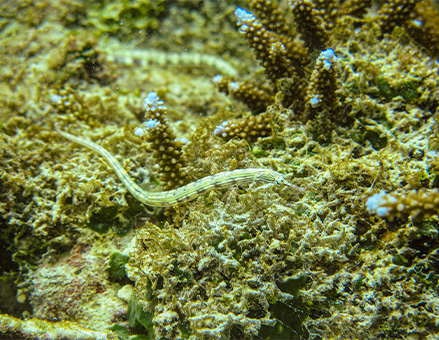
Lakshadweep’s coral reefs, vital for food security and coastal protection, have declined by 40% over two decades due to repeated coral bleaching events linked to El Niño and rising sea temperatures. With reefs nearing their thermal limits, reducing local pressures like extractive use became critical for their recovery and resilience. Built on the declaration of 3 conservation reserves covering 675 sq. kms – a result of over 2 decades of relentless efforts and growing commitment of both government and communities. The degradation of coral reefs was intensifying and the time was right to expand conservation efforts. In collaboration with Srushti Conservation Foundation (SCF), a new 200 km2 conservation reserve covering coral reef ecosystems was being proposed. A participatory management plan was co-developed with communities and stakeholders to ensure long-term protection and sustainability of these fragile ecosystems.
Conservation Action:
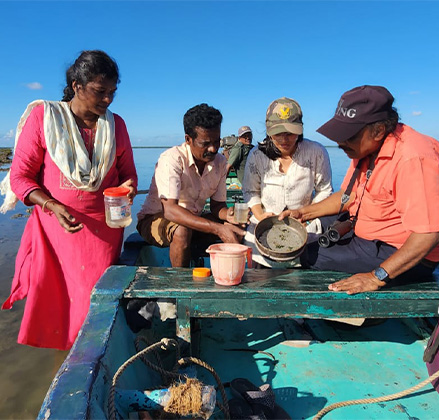
The project targeted three reef sites—Agatti, Bitra, and Perumal Par—in Lakshadweep to identify the most resilient for designation as a Conservation Reserve. Community consultations and traditional knowledge assessments highlighted local reliance on key reef species like baitfish and octopus.
Key actions included:
- Scientific documentation of reef ecosystems through literature and field surveys.
- Established systems for recording traditional knowledge on coral biodiversity.
- Community and stakeholder consultations on reef usage and dependence.
- Data analysis to define boundaries of proposed conservation reserve.
- Training community members in reef monitoring and management.
- Promoting best practices in reef conservation and sustainable resource use.
- Conducting market and value chain assessments for resource-based livelihoods.
- Engaging local authorities for overall reserve planning.
- Co-developing a management plan for the proposed reserve.
Impact:
- Rapid surveys covered 5% of total island lagoon areas: 1.4 km² (Agatti), 2.2 km² (Bitra), 4 km² (Perumal Par).
- Biodiversity Committees formed at Agatti and Bitra; each developed a People’s Biodiversity Register (PBR).
- 20 men, 20 women received training in coral reef conservation management.
- Two women’s Self-Help Groups established to promote alternative livelihoods through crafts.
- A best practices publication in sustainable reef resource management was produced and shared.
- A comprehensive management plan was submitted to the Lakshadweep UT administration for Ministry of Environment, Forests and Climate Change (MoEF & CC) approval.
Coral Reef Restoration Project, Mithapur
Challenges:
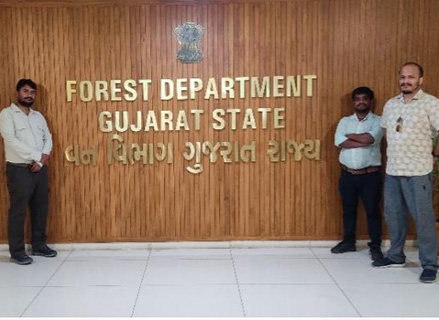
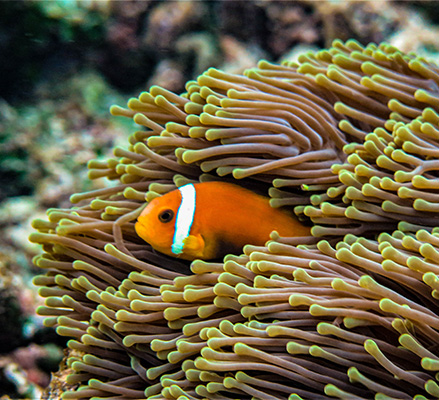
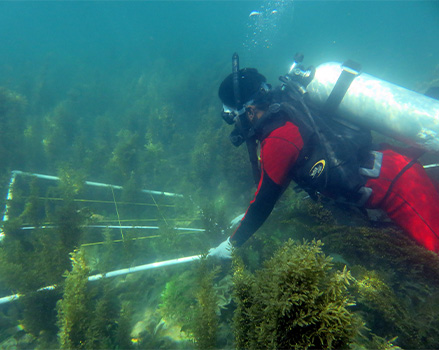
The Mithapur reef, on the western edge of the Gulf of Kutch, supports 350 families through fishing, chunk collection, and seaweed harvesting, while stabilizing the shoreline. However, it faces severe stress from storms, siltation, sand mining, and coastal development. Live coral cover has only slightly improved from 12% in 2008 to 18.02% in 2023—still poor by global standards. Major threats include algal overgrowth, sedimentation, and artisanal fishing pressures. To address this, the Mithapur Coral Reef Recovery Project – led by Wildlife Trust of India in association with the Gujarat State Forest Department and Tata Chemicals Ltd. – aims to restore 12 sq. km of the reef through a public-private-community collaboration. The project combines cutting-edge techniques like coral micro-fragmentation and Biorock technology with established methods such as artificial reefs, coral gardens, and no-take fishing zones.
Conservation Action:
- Establishing a marine wet-lab for coral micro-fragmentation and nursery-grown coral acclimatization.
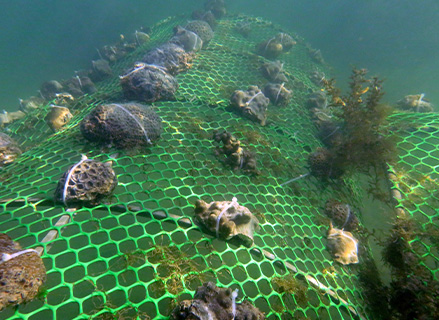
- Installation of 2 Biorock systems to boost coral growth via electrically stimulated mineral accretion.
- Deployment of 200 new artificial reef modules using limestone and basalt to expand coral colonization, now covering 5,350 sq. m. area.
- Creating a fourth new coral garden to support local coral nurseries.
- Expansion of no-take fishing zones by 50,000 sq. m, now covering 200,000 sq. m. area.
- Awareness workshops and clean-up drives involving 300+ stakeholders, including fishing communities, students, Coast Guard, and Forest Department.
- Training the fishing community in reef monitoring techniques.
- Conducting citizen science and reef health monitoring twice a year, supported by volunteers and locals.
Impact:
- Artificial reef area increased to 5,350 sq. m, enhancing ecosystem recovery, coral colonization, fish habitat and fisher livelihood.
- Project area expanded from 5 to 12 sq. km, covering reef areas from Jangleswar to Sagar Dam.
- Live coral cover is projected to rise from 18.02% to 20% by 2024–25, with an aim to reach 25% by 2026–27.
- A trained local network of reef monitors ensures long-term conservation and monitoring sustainability.
Whale Shark Conservation, Gujarat
Challenges:
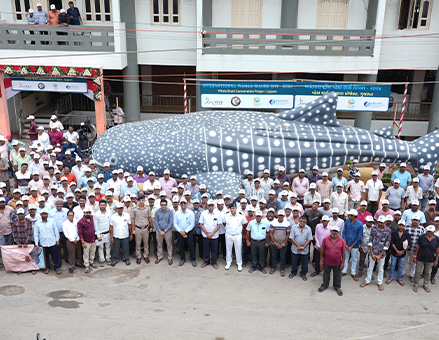
Launched in 2004 by Wildlife Trust of India with the Gujarat Forest Department and Tata Chemicals Ltd., the project protects the endangered whale shark (Rhincodon typus) along Gujarat’s coast. The project has successfully transformed public perception—turning former hunters into guardians of this gentle giant. What began as an awareness campaign evolved into a community-led movement that ended targeted killings and led seven municipalities to adopt the whale shark as a mascot. A government compensation scheme for damaged fishing nets further encouraged conservation. Today, accidental entanglement remains the main threat. Sustaining fisher engagement, improving rescue protocols, and promoting digital tools like the Vhali Watcher app are key to ensuring long-term, community-driven protection.Conservation Action:
A multi-faceted action plan of conservation science, technology and public engagement is being led by WTI with C-SCAPES, TCSRD, Tata Chemicals Ltd. and the Gujarat Forest Department.
Key actions included:
- Train fishers in refined SOPs for safe whale shark rescues using self-developed tools to minimize risk, stress, and injury to both rescuer and animal.
- Distribute localized training materials that include animated videos and SOPs in Gujarati.
- Enable fishers to document rescues via the Vhali Watcher app with offline geo-tagging feature – creating a verified digital trail of each incident.
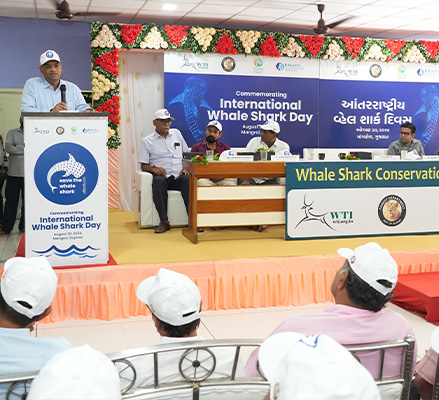
- Celebrated Whale Shark Day with art, cultural events, and school outreach programmes involving Tata Chemical employees, officials and coastal children.
- Reward schemes for reporting whale shark neonate sightings to study their breeding patterns
- Train forest staff and Coast Guard in whale shark identification, monitoring, and rescue coordination to boost offshore conservation.
- Produce a documentary highlighting 20 years of collaborative conservation, showcased globally.
- Conduct a post-campaign survey to assess community awareness and training needs for younger fishers.
- Procure five satellite transmitters to study their ecology and migratory / breeding routes.
Impact:
- 958 whale sharks, including 14 neonates, rescued and released along Gujarat’s coast.
- Zero intentional killings reported along the Saurashtra coastline due to widespread local support and robust rescue protocols.
- 4,500 fishers (25%) across Sutrapada, Dhamlej, Veraval Bhidiya, and Mangrol trained in latest rescue methods.
- 40% of rescues digitally recorded via the Vhali Watcher app, streamlining data collection and net loss compensation.
- 10,000+ people engaged through outreach and school programmes, including students, fishers, officials, and Coast Guard.
- 5 new satellite tags procured to study whale shark migration and behaviour.
- A globally recognized, sustainable and community-led conservation model successfully strengthened.
Conservation and sustainable management of coastal ecosystems for increased resilience to climate change in Cuddalore district, Tamil Nadu
Challenges:
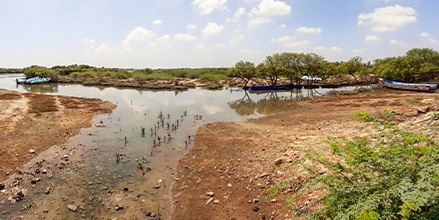
Cuddalore district, Tamil Nadu, with a 42 km coastline and low-lying terrain, is highly vulnerable to tropical cyclones causing severe floods and destruction. Bordered by the Pennayar and Gadilam rivers, it frequently faces severe cyclones—nearly 60 in the past century as per IMD’s eAtlas (2011). Repeated damage by these storms to Cuddalore town highlights the urgent need for nature-based resilience solutions.
Conservation Action:
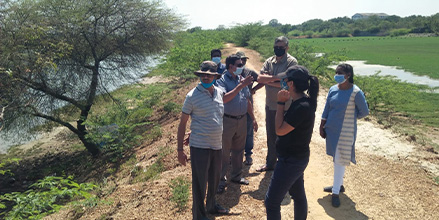
To build coastal resilience and strengthen natural defences against erosion, storm surges, and sea level rise, following interventions were undertaken:
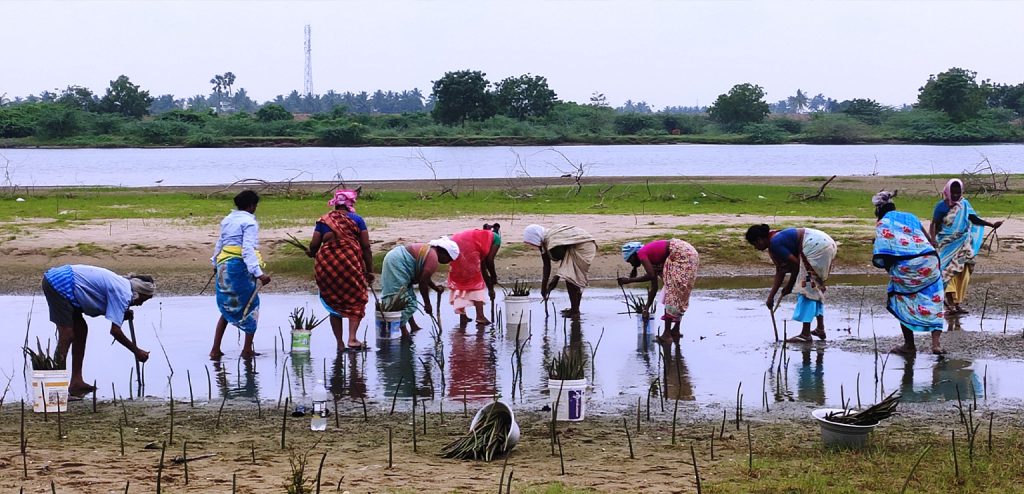
- Mangrove Bioshield Restoration: Restoring mangroves along the Gadilam river mouth in Devanampattinam to reduce the storm impact and enhance ecosystem services.
- Community-Based Conservation and Governance: Mangrove Conservation Committees formed to co-develop protection, governance and monitoring system for the coastal area.
- Carbon Stock Assessment: Using Remote Sensing / GIS tools to assess carbon stocks of both natural and restored mangrove patches, for climate mitigation and long-term monitoring.
Impact:
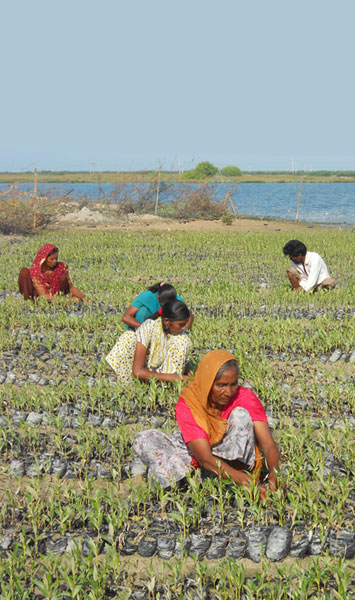
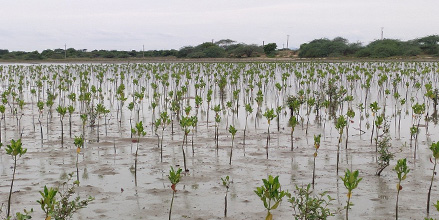
- In 2023–24, approx. 30,000 mangrove saplings were planted across three villages in Cuddalore district with 60-80% survival rate. In 2024–25, 24,000 additional saplings were planted, while 6,000 saplings were replaced due to flood-related mortality.
- A mangrove bio-shield is created to protect infrastructure from natural disasters and saline water intrusion into Cuddalore town.
Conservation and sustainable management of coastal ecosystems for increased resilience to climate change in Nellore district, Andhra Pradesh
Challenges:
Pulicat Lake, India’s second-largest brackish lagoon, faces ecological stress from siltation and seasonal bar mouth closure, leading to increased turbidity, poor water exchange, reduced depth, and declining water quality.
Adjacent to this ecosystem is the Vatambedu Kuppam village in Nellore, AP. Freshwater scarcity and saline intrusion into the farmlands have led to sharp decline in agricultural productivity, directly affecting around 50 families. Around 150 families from the fishing community reported reduced fish catch and increased effort in Pulicat Lake, attributed to habitat degradation and lagoon mouth closure. Ethalabai Lake, the region’s key water source, faces a significant drop in its storage capacity (from 2 million to 1.2 million cubic meters). Plans to deepen 99 acres of elevated lakebed will increase this capacity by 2,40,000 cubic meters or 20%.Conservation Action:
The project supports a landscape-level restoration and conservation initiative that links coastal, brackish, and freshwater ecosystems.
Key actions included:
- Restoring Water Flow & Retention: Freshwater wetlands in VattambeduKuppam are restored, boosting water availability for farming and domestic use.
- Mangrove Bioshield: Mangroves planted along farm fields near Buckingham Canal to protect against saline intrusion and erosion.
- Seagrass Restoration: 10 hectares of seagrass bed will enhance fish breeding and fish catch.
- Mangrove Plantation: 53,000 saplings in 2024-25 and 50,000 in 2023-24 to protect 100+ hectares of farmland.
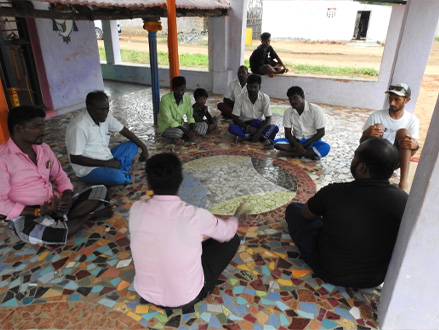
- Community Governance: Village Water Management and Mangrove Conservation Committees established for equitable water use and ecosystem stewardship.
Impact:
- Water availability increased by approx. 20%. Also, storage capacity increased by 20%.
- Water-user association formed to supervise equal water use in the village.
- 1 hectare of seagrass planted near Kondurupalem. Another 4 hectares each are scheduled near Pulicat lake shorelines. It will benefit 150+ fishing families.
Marine Megafauna Stranding Network – Gujarat
Challenges:
Gujarat’s 1,596 km coastline hosts diverse marine megafauna, but lacks a coordinated stranding response system. Despite frequent strandings of species like whale sharks, dolphins, and turtles, data is limited and response efforts are constrained by remote terrain, industrial activity, limited veterinary access, and low community awareness.
Reports of dolphin carcasses used as bait, inaccessible beaches between Porbandar and Okha, and fear among fishers about reporting strandings all highlight the urgent need for a strategic and community-driven approach. This project aimed to establish the foundation for a state-wide response network through assessments, partnerships, and capacity building.Conservation Action:
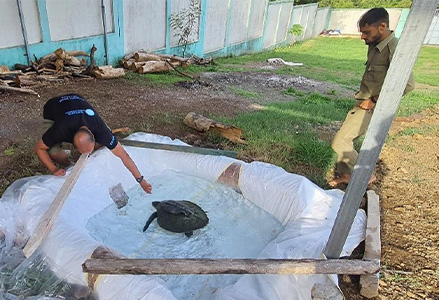
ReefWatch, in collaboration with C-SCAPES, initiated Gujarat’s first formal marine megafauna stranding response system.
Key actions included:
- Conducted field surveys across three coastal zones and interviewed 70+ fishers to map high-risk areas and document local knowledge.
- Secured permissions from the Gujarat Forest Department and engaged key officials for future implementation.
- Identified potential treatment/transit centre sites in five coastal towns, including a hatchery at Mandvi.
- Trained two vets and a local coordinator in turtle and seabird treatment, rescue protocols, data collection, morphometrics, post-mortems, buoyancy therapy, diagnostics, and communication with officials.
- Launched a WhatsApp-based reporting network with 70+ members, which has reported 35 strandings (9 live).
- Ran awareness campaigns and distributed materials to improve community participation and reduce fear of reporting.
- Successfully treated a sea turtle using telemedicine, demonstrating feasibility of remote veterinary interventions.
Impact:
- Established Gujarat’s first baseline on marine megafauna strandings, identifying high-risk zones and species.
- Trained two veterinarians and one state coordinator in rescue, treatment, and stakeholder engagement.
- WhatsApp-based network helping locate animals in distress.
- Piloted Gujarat’s first telemedicine-assisted marine megafauna treatment.
- Developed a detailed three-year roadmap outlining a scalable, community-driven response system.